Guangzhou Salvage Bureau: Witnessing the Ingenuity of a Great Nation in Millimeters
This is an inspiring historical moment!
On July 8, the project "Key Technologies, Equipment, and Applications for the Construction of Steel Shell Concrete Immersed Tube Tunnel in the Shenzhen-Zhongshan Corridor," with the Guangzhou Salvage Bureau of the Ministry of Transport as a core participating unit, won the First Prize of the 2025 National Science and Technology Progress Award. This marks that the Guangzhou Salvage Bureau has paved a path of independent innovation and high-quality development in the field of ultra-large cross-sea immersed tube tunnel construction.
Behind the honor lies the journey of overcoming challenges through countless ordinary days and nights.
The S08 section on the east side of the Shenzhen-Zhongshan Link underwater tunnel encompasses all six non-standard pipe segments of the project, combining five world-class technical challenges: "super width, variable width, deep burial, large back-siltation volume, and poor stability in the sand excavation area."
Facing challenges head-on, true strength is revealed—The Guangzhou Salvage Bureau completed the installation of 9 immersed tube sections in 11 months, achieving millimeter-level alignment for all connections. Among them, the horizontal axis deviation of the E24 section was 0 millimeters, and the deviation of the E28 section was only 0.2 millimeters. The project team of the Guangzhou Salvage Bureau not only improved the alignment precision of similar immersed tube tunnels worldwide from centimeter-level to millimeter-level but also drove a systematic innovation in the construction techniques of immersed tube tunnels globally.
A salvage team, what gives them the confidence to tackle the tough challenge of the Shen-Zhong Link? The answer lies in the confidence of independent innovation, in the persistence of striving for every millimeter, and in the 30-year relay of a dedicated salvage iron army.
Shouldering Heavy Responsibilities
Actively Shoulder the National Mission
On the Lingdingyang, a long rainbow lies across the waves.
The Shenzhen-Zhongshan Link, integrating "bridge, island, tunnel, and underwater interchange" into one, spans approximately 24 kilometers and is one of the most challenging cross-sea cluster projects in the world in terms of comprehensive construction difficulty. The underwater tunnel is 6,845 meters long, with the immersed tube section measuring 5,035 meters, consisting of 32 pipe segments and one final joint—the world's first bi-directional eight-lane steel-shell concrete immersed tube tunnel.
On June 30, 2024, the Shenzhen-Zhongshan Corridor will be completed and opened to traffic, reducing the travel time from Shenzhen to Zhongshan from two hours to within half an hour. Since its opening, the daily average traffic volume has exceeded 100,000 vehicles, making it a core transportation hub in the Guangdong-Hong Kong-Macao Greater Bay Area.
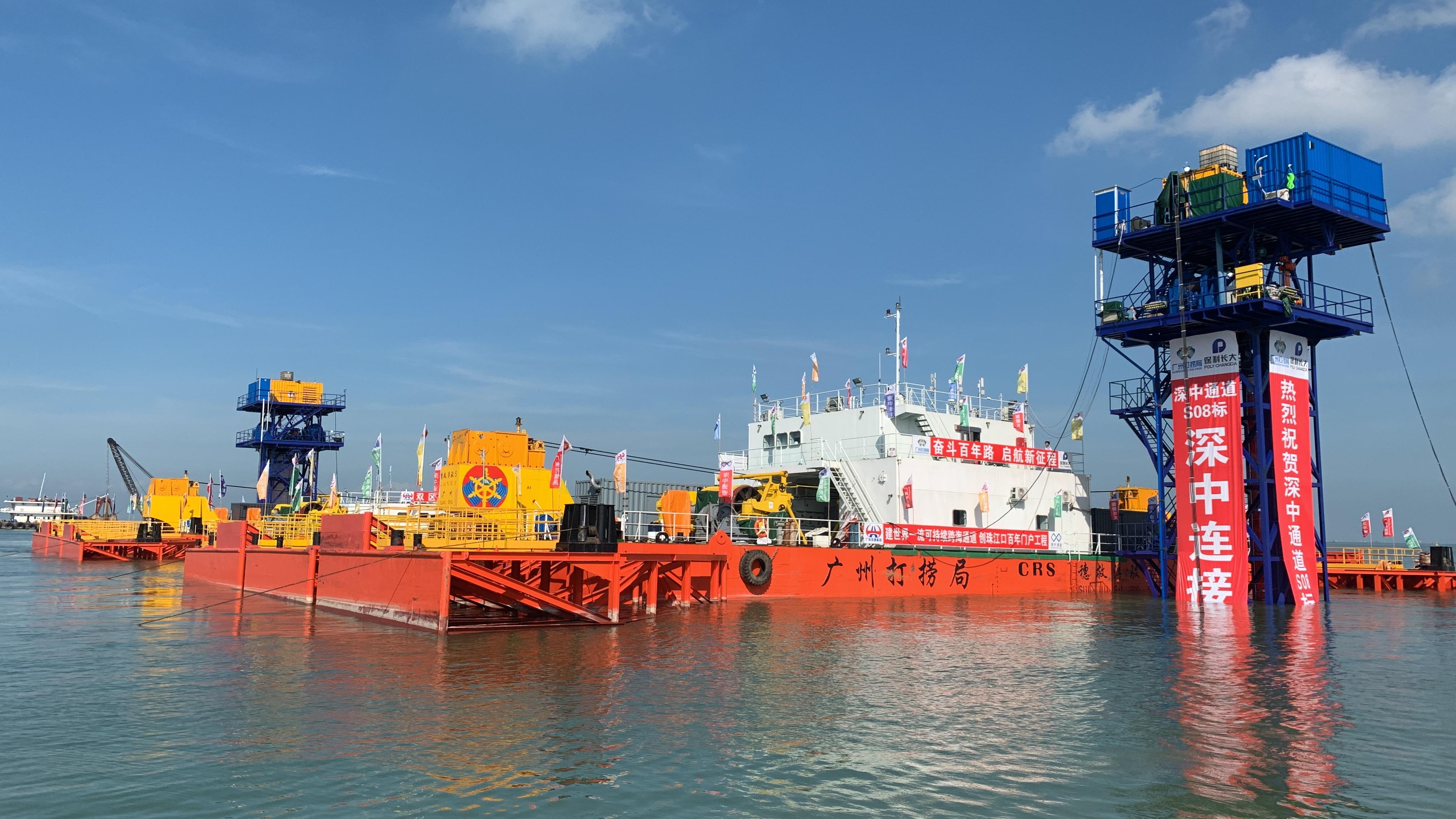
In the world's widest underwater immersed tunnel, the Guangzhou Salvage Bureau is responsible for the docking, floating transportation, installation, and internal construction tasks of 9 pipe sections from E32 to E24 in the eastern S08 contract section. These pipe sections include all 6 non-standard sections of the project, each being a unique challenge.
E32 pipe section, the world's widest variable-width pipe section, with a maximum width of 55.46 meters and ten lanes in both directions; E27 pipe section, the pipe section with the largest casting volume in the project, weighing approximately 80,000 tons after casting; E30 pipe section, the pipe section with the greatest curvature variation in the project, with a width variation of up to 4 meters... Ultra-wide, variable-width, deep burial, large back-silt volume, poor stability in sandpit areas—five world-class technical challenges combined, with no domestic technical standards for reference or guidance.
The installation of immersed tubes is one of the toughest "bones" in the construction of the Shenzhen-Zhongshan Link. The hardest part of this "bone" was handed over to the Guangzhou Salvage Bureau.
“The Shenzhen-Zhongshan Corridor is a major national project and a core transportation hub of the Guangdong-Hong Kong-Macao Greater Bay Area.” Upon receiving the S08 section task, Kong Weida, project manager and Party branch secretary of the S08 contract section of the Shenzhen-Zhongshan Corridor at the Guangzhou Salvage Bureau, responded with, “The mission is glorious, and the responsibility is immense.”
An 80,000-ton pipe section achieves millimeter-level docking at a depth of 40 meters, with no existing experience to draw upon; the underwater tunnel is a concealed project, and even the slightest installation deviation could result in irreparable losses.
“There is pressure, but there is also confidence! We are not fighting alone; the entire team is working hard together.” Confidence and determination shone in Kong Weida's eyes.
This confidence stems from the Guangzhou Salvage Bureau's profound experience of over 30 years in immersed tube tunnel construction.
From the Ningbo Yongjiang Immersed Tube Tunnel, to the Guangzhou Pearl River Tunnel, and then to the Nanchang Honggu Tunnel and the Hong Kong Shatin-Central Link Cross-Harbour Tunnel—one immersed tube after another traverses beneath rivers and seas like "dragons," connecting the technological leap of Guangzhou Salvage Bureau from following to running alongside and then leading. The construction and installation techniques of immersed tubes have reached a world-leading level.
From "feeling the stones to cross the river" in Ningbo Yongjiang, to independently setting international standards for the Shen-Zhong Channel, over the years, the leap in China's immersed tube technology has never been a moment of individual brilliance, but rather the continuous efforts of generations of builders turning the "impossible" into "possible."
For more than 30 years, the Guangzhou Salvage Bureau has filled the gap in our country's foundational construction methods for the immersed tube tunnel field, including the pre-laying and post-laying methods. It has pioneered practices such as on-board construction of tunnel segments and participated in drafting national technical standards like the "Design Standards for Immersed Tube Tunnels," playing a significant role in the development of our country's transportation infrastructure.
“What the country needs, rise to the challenge!”
“Having dealt with the sea for decades, we have never yielded in the face of storms!”
......
In June 2018, after the Guangzhou Salvage Bureau and the Shen-Zhong Link Management Center completed the construction contract signing, declarations of commitment echoed along the Lingdingyang coast. Entrusting the most challenging section to the Guangzhou Salvage Bureau was not only a proactive undertaking to serve the construction of the Guangdong-Hong Kong-Macao Greater Bay Area but also a solemn promise to fulfill the national mission.
Independently Developed
Overcoming the Core Technology of Immersed Tube Installation
Looking back at the construction journey of the Shenzhen-Zhongshan Passage project, what comes into view is the vivid practice of Guangzhou Salvage Bureau's solid efforts in promoting technological innovation and equipment upgrades.
“Just as building a road requires a foundation, laying immersed tubes also requires laying a layer of foundation beneath the tube sections to ensure that the sections are supported by enough flat surfaces,” explained the project's chief engineer, Li Wanghui, using an analogy. This foundation is the most critical line of defense for controlling the elevation of the tube sections, and the difficulty of laying it can be easily imagined.
To ensure that an 80,000-ton pipe section can stably "lie" at a depth of about 30 meters underwater, it is necessary to first lay out evenly distributed gravel "beds" on the seabed. However, the core technology, equipment, and software for gravel laying have long been monopolized by foreign countries, and technical blockades have cut off the path of external support.
“Then we will build it ourselves.” Faced with the "roadblock" in technology, the Guangzhou Salvage Bureau project team forged ahead—The Shen-Zhong Link is a world-class project, and only by mastering the core technology in our own hands can we have absolute authority.
This sentence sounds powerful when spoken, but implementing it is like walking on thin ice.
“Developing a world-first ship with a detachable frame engineering design involves a significant technological leap. If it fails, it not only risks massive financial losses but could also delay the project schedule.” Doubts arose, but the project team insisted on independent development.
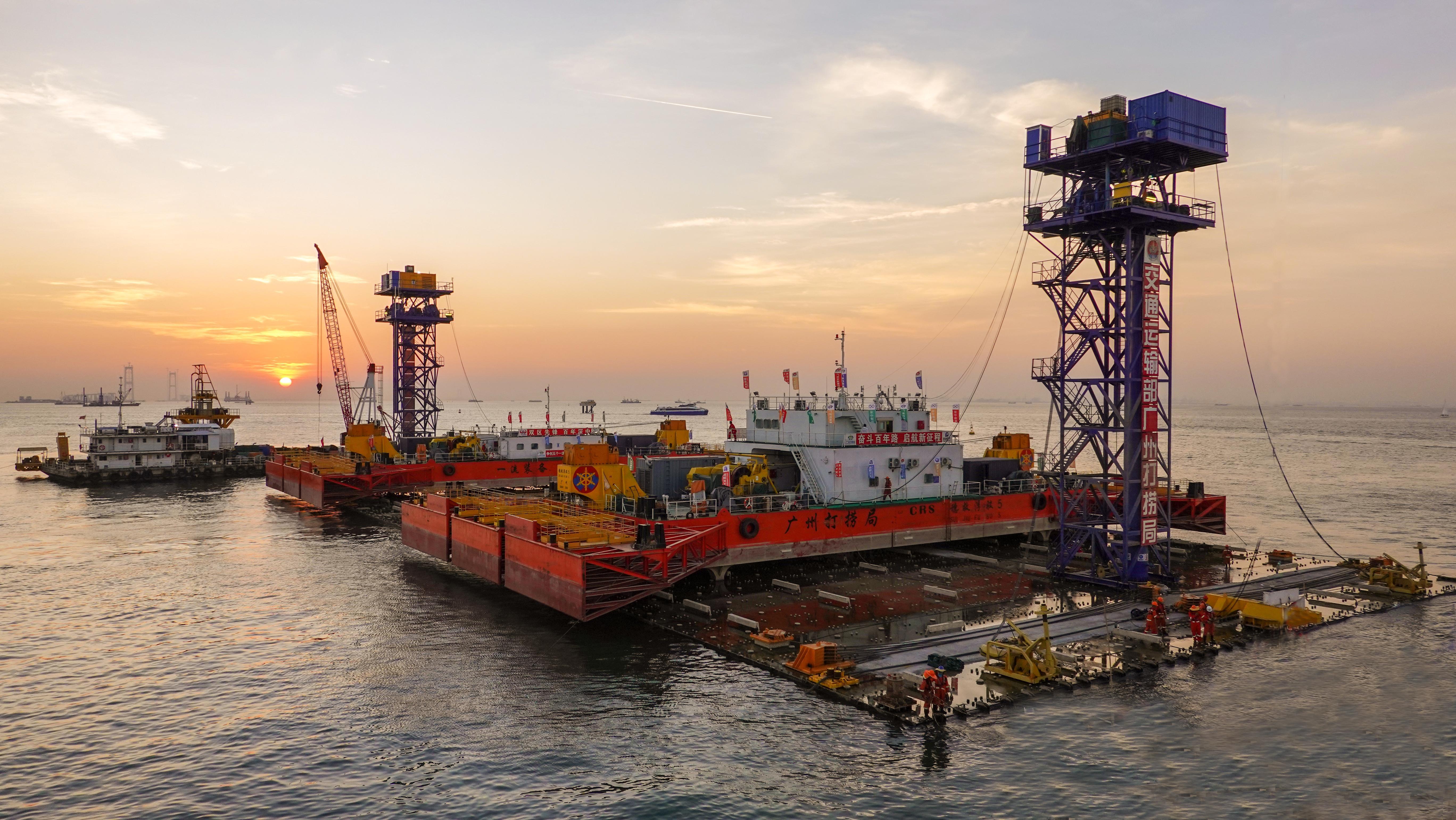
Mindset determines the path forward. Under the collaborative innovation of multiple organizations, the "Zhongren 801" vessel was born in response to the situation—designed for a water depth of 60 meters, with a maximum capability of exceeding 100 meters. It is the world's first specialized underwater gravel leveling engineering vessel featuring a detachable ship frame and integrating both foundation leveling and fixed-point dredging functions.
“The traditional industry-standard stone leveling vessels use an integrated pile-driving structure, which is expensive, limited in adapting to bed widths, and has certain geological requirements. However, the 'Zhongren 801' vessel features a separated frame design. The most critical breakthrough lies in its bottom-sitting leveling frame, which can adapt to various geological conditions and any bed width,” Li Wanghui explained. During operation, the vessel's frame is placed on the seabed surface, and by adjusting buoyancy, it can operate stably even on complex geological conditions. By dividing the foundation into sections, it enables diverse expansion of foundation leveling methods, something that integrated vessel designs cannot achieve.
At the same time, the split design allows the hull and the operational frame to bear forces independently, effectively isolating the interference of sea wind and waves on underwater leveling operations, addressing the pain point of traditional ship designs where "ship movement causes frame movement, leading to loss of precision."
“This is a groundbreaking innovation for the extreme working conditions of the Shenzhen-Zhongshan Link, not just a simple upgrade.” In the view of project construction manager Jiang Zhibin, the significance of the "Zhongren 801" vessel goes far beyond the equipment itself. It signifies that in the field of foundation leveling for immersed tube tunnels, our country has transitioned from 'buying others' ships' to 'others coming to learn from our ships.'
The "Zhongren 801" ship's pioneering transverse section staggered paving technique is the first of its kind in the world. Combined with an intelligent measurement and control system, it maintains leveling precision within ±2.5 centimeters, achieving the highest domestic and internationally leading standards. It can complete approximately 10,000 cubic meters of gravel foundation paving within 4 days and has obtained over 20 national patents.
If the "Zhongren 801" ship completes the "bed" for the pipe sections, then the intelligent decision-making system is the construction team's "sharp eyes." 30 meters underwater, how can millimeter-level precision be achieved?
Underwater visibility is poor, making it almost impossible to complete docking relying solely on personnel diving and visual observation.
The Guangzhou Salvage Bureau, in collaboration with multiple organizations, has developed an auxiliary decision-making system for immersed tube tunnel construction. This "Insight" system relies on various sensors to collect all-dimensional data around the clock. Through independently developed algorithms, it quickly analyzes and adjusts construction parameters automatically. The analysis results are then converted into operational commands to coordinate with the immersion barge control system, creating a complete "collection-analysis-execution" closed loop.
By observing a part, one can infer the whole. The project team has made steady progress in areas such as technological innovation. In the environment adjacent to Shenzhen Bao'an Airport, which has extremely strong electromagnetic interference, they built the BeiDou satellite navigation and positioning system, consistently maintaining millimeter-level positioning accuracy. Addressing the rapid sediment accumulation in the highly silted waters of the Pearl River Estuary, they established a seamless operation model of "dredging—spreading—verification—placement," solving the problem of silt coverage... These innovative technologies have played a significant role in immersed tube construction.
Striving for Perfection
Achieving Millimeter-Level Docking of Immersed Tubes
In August 2021, the world's widest pipe section E32 was floated across the Lingding Channel at night. A formation of 8 tugboats was assembled, with the asymmetric pipe section experiencing complex water flow forces, fluctuating maritime visibility, and dense passing vessel traffic.
The technical team stayed on duty overnight, monitoring the ship's posture, water flow velocity, and positioning data, keeping a close eye on the decision support system throughout, and continuously analyzing and adjusting the formation plan in real-time. After a sleepless night, when the pipe section safely arrived at the sinking area and the morning light appeared on the horizon, the team's tense hearts finally relaxed.
The process of the E32 pipe section leaving the dock is an extreme race against the tidal window. When the 10.6-meter-high E32 pipe section leaves the dock, the shallowest water depth is only 8.3 meters, leaving very little excess depth.
“It is necessary to wait for a tide level of 2.6 meters, and the duration of this tide level on that day is only about 4.5 hours.” Li Wanghui said that during this short 4.5 hours, all processes must be seamlessly connected, leaving no room for the slightest delay.
The most thrilling part is the posture control at the moment when the shallow-water, ultra-wide pipe section leaves the dock—any slight water flow disturbance could lead to major risks such as the pipe section scraping the bottom, scratching, or getting stuck.
The launch of E32 was the most thrilling start among the 9 pipe sections. Meanwhile, the submersion of E24 was the most breathtaking finale.
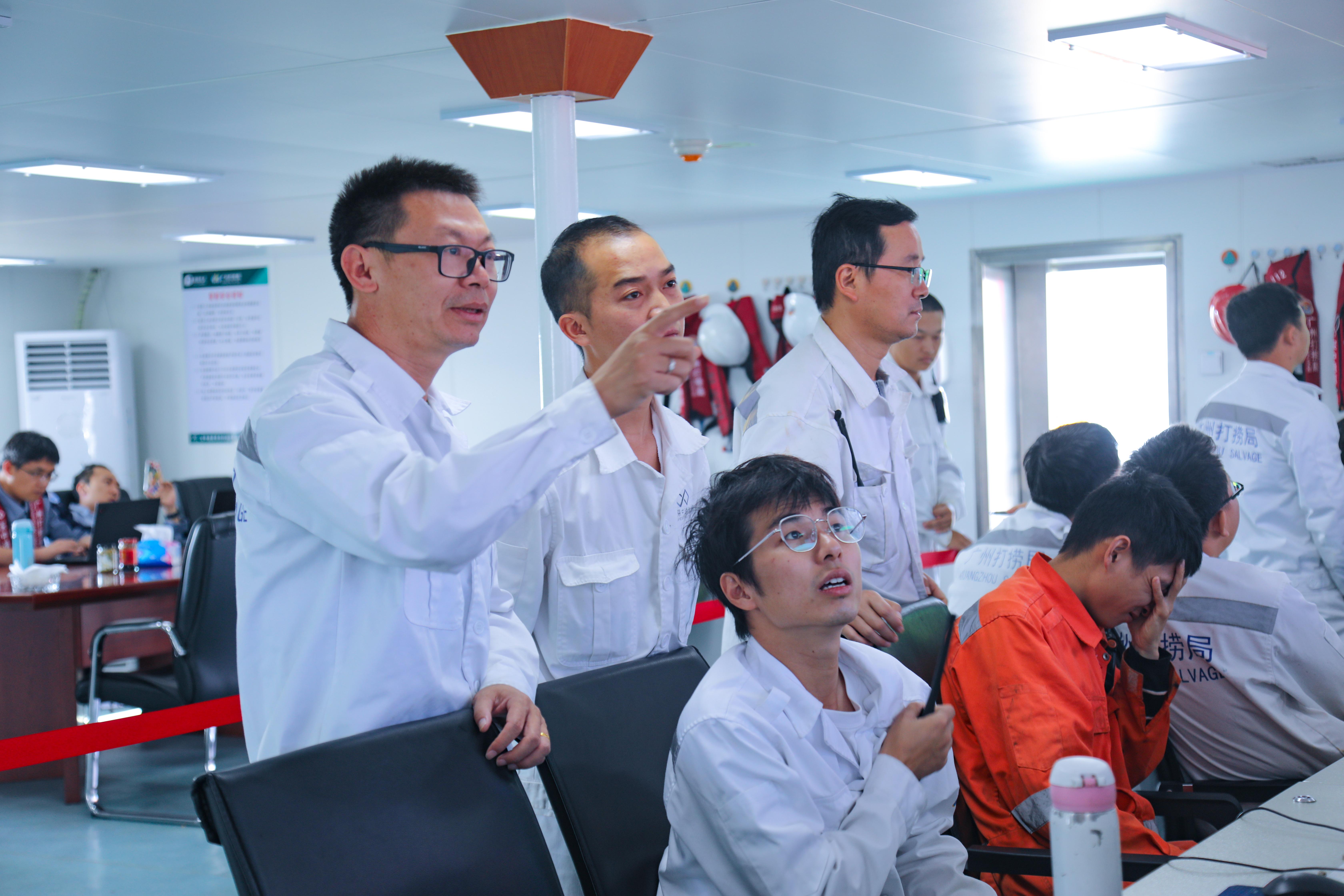
As the last segment of section S08, the installation of E24 encountered unexpected challenges such as excessive siltation in the foundation trench and extremely poor stability in the sandpit area. Just as the "Zhongren 801" vessel completed the foundation paving, monitoring data showed abnormal fluctuations in the foundation's flatness—the atmosphere in the command room suddenly became tense, and everyone's eyes were fixed on the numbers flickering on the screen. Forcing the segment to sink would make the 80,000-ton segment highly prone to tilting, making millimeter-level docking impossible.
In the face of danger, the project team launched a "three-step" emergency response—
Precise "diagnosis." Overnight deployment of the "Zhongren 801" vessel's intelligent measurement and control system for high-density re-surveying, combined with multi-source monitoring data to pinpoint unstable boundaries, achieving millimeter-level "lesion" localization. Technicians stared at the screen, comparing data frame by frame, marking every abnormal fluctuation's coordinates on the nautical chart.
Targeted "treatment." Temporarily adjust the operation mode, using the original "cross-section segmented staggered paving" technique to pinpoint, layer, and stagger reinforcement in abnormal areas. Like a "minimally invasive surgery" under the sea, it allows gravel to be precisely laid in murky underwater conditions, without disturbing the already submerged pipe sections while ensuring a seamless connection between the reinforcement layer and the original foundation.
Dynamic "verification." After reinforcement, divers were arranged to conduct multiple underwater inspections, while an intelligent monitoring and control system was used to continuously monitor settlement. One day, two days, the data curve finally stabilized, remaining within ±2.5 centimeters and consistently meeting the standard.
On July 22, 2022, the sinking instruction was issued. An 80,000-ton pipe section was slowly submerged into 40 meters of deep water, and the numbers on the attitude sensor gradually narrowed—10 millimeters, 5 millimeters, 1 millimeter... Finally, the E24 pipe section achieved a perfect alignment with a lateral offset of 0 millimeters on the planar axis.
“As a project manager, my greatest feeling is not pride, but relief and reverence. Relief that we have delivered a satisfactory answer to the country and the people; reverence for the Chinese precision forged by the sweat and wisdom of countless builders behind the mega project.” When the results of the alignment measurement were transmitted back to the command room, Kong Weida let out a long sigh of relief, and his clenched fist slowly relaxed.
This 0 millimeters is not a cold number; it represents the project team's almost obsessive pursuit of "millimeter-level" precision. The Guangzhou Salvage Bureau, with performance exceeding design standards, has created the "Shenzhen-Zhongshan Precision."
Equally astonishing as the precision is the speed.
In just 11 months, all 9 immersed tubes were completed and installed. From August to December 2021, the project team achieved an efficient construction pace of "one tube per month" and even "two tubes per month," marking the first time in China that one large immersed tube was installed every month for six consecutive months.
“One festival per month is not about blindly rushing the schedule.” Jiang Zhibin explained that the Guangzhou Salvage Bureau has completely broken the traditional model of "sequential construction and process waiting," establishing a comprehensive construction system of "parallel operations, overlapping construction, and closed-loop connection." Once the previous process passes inspection and meets standards, it is seamlessly handed over to the next process immediately, ensuring zero waiting and zero gaps.
Beyond speed, quality is another iron gate.
The project team conducted two watertightness tests to ensure the immersed tube is "completely leak-proof." The independently designed segment storage system can withstand typhoon conditions that occur once in 50 years and has undergone multiple real-life typhoon tests, with all data remaining stable and meeting the standards.
Speed and precision go hand in hand, backed by meticulous attention to every detail. From the "Shenzhen-Zhongshan Speed" to the "Shenzhen-Zhongshan Precision," the Guangzhou Salvage Bureau has set a new benchmark for immersed tube tunnel construction in China with "11 months" and "9-section millimeter-level docking."
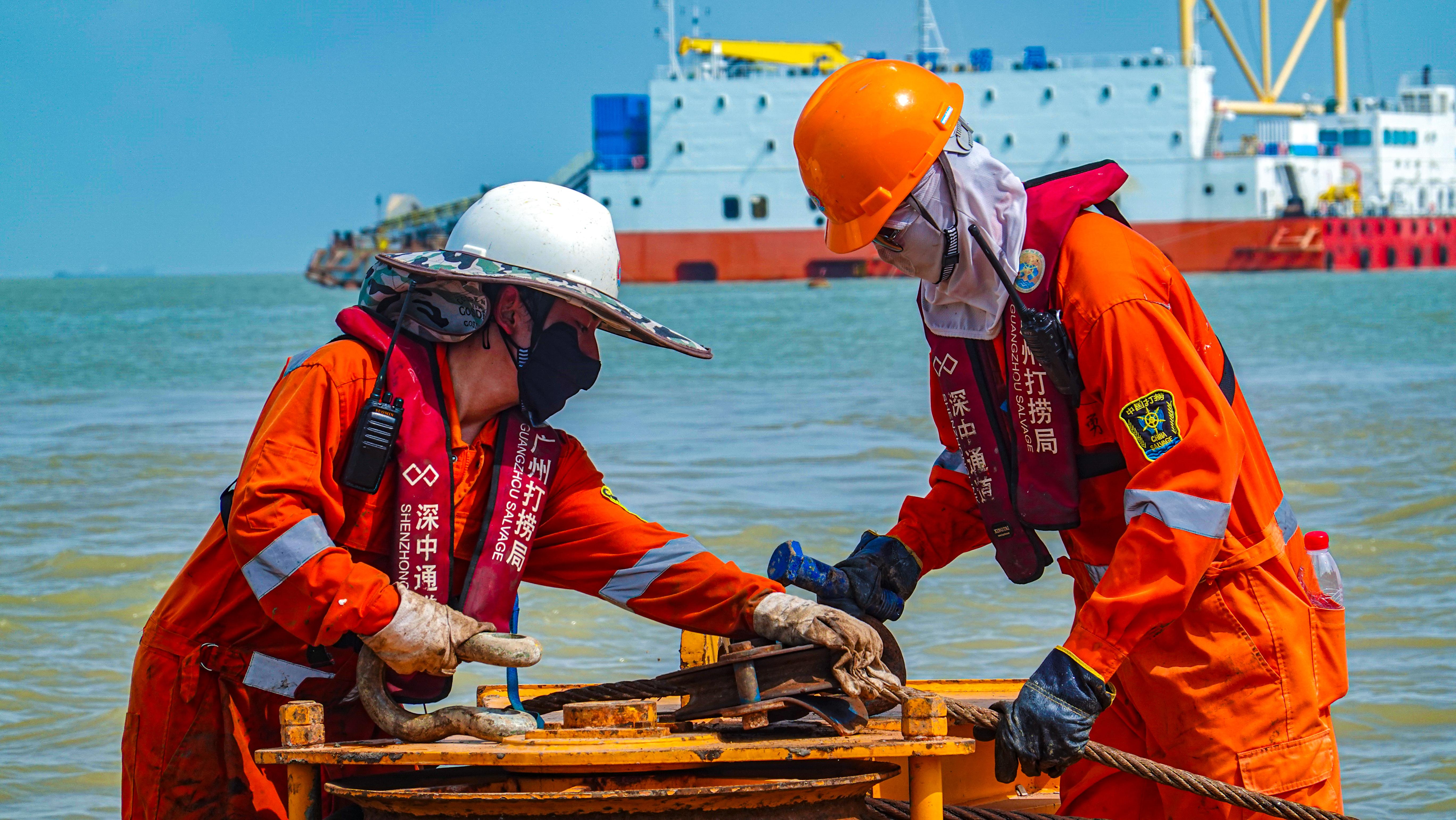
Party Building Leadership
Inheriting the Spirit, Uniting Strength
“Chasing dreams in the Bay Area, creating the precision of Shen-Zhong; charging forward at Lingding, showcasing the salvage spirit.” The slogan of the young construction team of the S08 section of the Shen-Zhong Link project resounds through the blue sky and clear waters.
Based in Guangdong, this "red hot land," the project team strengthens Party building leadership, creating a distinctive Shenzhen-Zhongshan Party building brand of "establishing Party branches on the project, letting the Party flag fly on the immersed tube, engraving vows on helmets, and writing achievements on the sea."
The first three years after the project was launched were the most challenging moments for the team. While other sections had already begun installing immersed tubes, the Guangzhou Salvage Bureau was still conducting repeated experiments for the development of core equipment like the "Zhongren 801" vessel. External doubts and tight deadlines weighed on the team like a mountain.
“We must have confidence and courage. The Guangzhou Salvage Bureau has been working on immersed tube tunnels for decades. Do we really have no confidence? The entire bureau is fighting, and we must also push forward.” As the Party Branch Secretary of the project, Kong Weida's resolute words ignited a fire in the hearts of the team members.
“Continue the red bloodline and lead high-quality project construction with high-quality Party building!” This is the answer of every Guangzhou salvage worker, and it is also the professional creed they have always upheld.
The project party branch established the "Three Innovations Studio" to inspire the exemplary role of party members, resulting in the development of 43 patents and multiple software copyrights. They implemented a "mentor-apprentice" program for new and experienced employees, leveraging the guiding role of the "Party Member Demonstration Post" to take the lead and spearhead efforts, guiding all builders to overcome challenges.
“In the past, our understanding of immersed tunnel construction was limited to books and drawings. However, in this project, we were fully involved in equipment debugging, on-site construction, technical problem-solving, and data review, personally witnessing the entire process of the full set of domestically developed core technologies from research and development to testing and practical application.” For young technical personnel Sun Shipeng, participating in the construction of the Shenzhen-Zhongshan Link was a valuable opportunity to grow alongside a major national project.
Sun Shipeng's words expressed the sentiments of many young technical staff members in the project team.
“The precision of Shenzhen-Zhongshan not only carries the dreams of the Greater Bay Area but is also a shared goal pursued by engineering constructors worldwide.” Ma Jiajie, a technician from the Guangzhou Salvage Bureau, deeply resonates with this sentiment. During the project, he was deeply involved in research on several applied topics, such as towing pipe sections through complex waterways and mooring for typhoon prevention.
In April 2024, the World Tunnel Congress was held in Shenzhen. Ma Jiajie witnessed international peers being captivated by China's independently developed ship-frame-separated gravel leveling and dredging vessel, as well as the millimeter-level precision achievements in immersed tube installation.
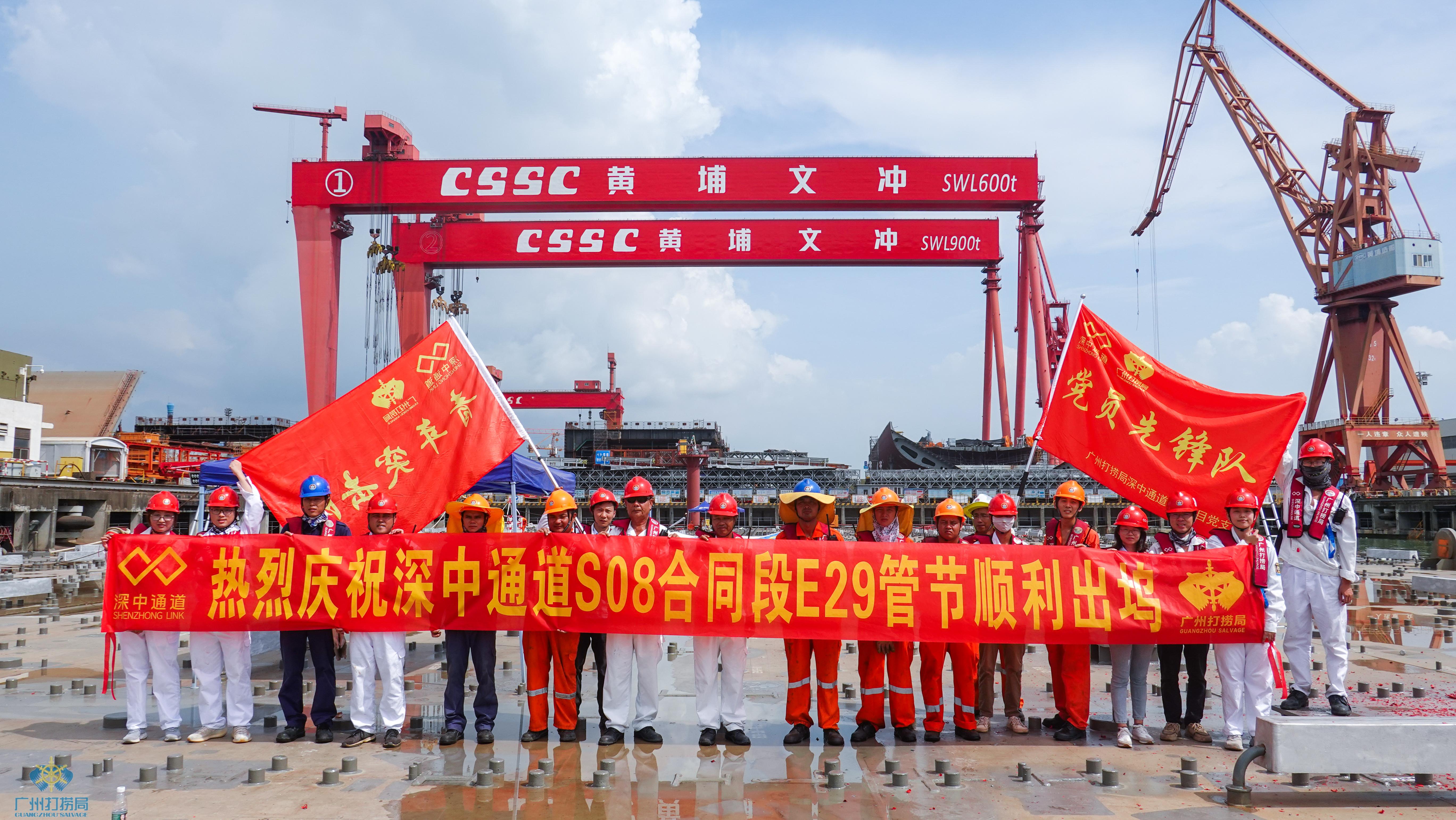
Those who share the same desire will prevail, and those who weather storms together will thrive. The project team of the Guangzhou Salvage Bureau has always maintained an unstoppable fighting spirit, writing engineering legends on the Lingdingyang waters.
The First Prize of the National Science and Technology Progress Award is not the end point, but a milestone for the Guangzhou Salvage Bureau from following to leading. The Guangzhou Salvage Bureau will take the construction of the Shenzhen-Zhongshan Corridor as a benchmark, closely focus on national strategic needs and industrial development layout, strengthen breakthroughs in core technologies such as deep-water construction and immersed tube tunnels, and the development of key equipment, continuing to act as a pioneer in better serving and accelerating the construction of a transportation powerhouse.
What changes are the equipment and technology, what remains unchanged is the original intention to serve the people and the spirit of rescue and salvage. Today, the gaze of Guangzhou's salvage workers sweeps across the vast ocean before them, reaching toward a broader horizon—that is the magnificent vision of accelerating the construction of a strong transportation nation, the symphony of an era of national prosperity.
-
October 08 International Shipping Trends5877
-
聚焦四个环节 天津海事局全力保障国庆假期涉水施工安全稳定3745
-
Tianjin New Port Maritime Bureau ensures safe loading and convenient shipping of large sintering machine equipment.4385
-
The Yangtze River Zhenjiang section has fully implemented the "Six All" digital closed-loop management system for operations involving hazardous chemical vessels.3505
-
Tianjin North Maritime Bureau Escorts "China's Intelligent Manufacturing" to Sail Overseas4473