
China Classification Society Shanghai Branch: Sixteen Years Witnessing China's Deep-Sea "Triple Jump"
Recently, the National Science and Technology Awards Conference was held, and the "Fendouzhe Full-Ocean-Depth Manned Submersible" won the Special Prize of the National Science and Technology Progress Award for 2025, becoming the only project in the general field of the National Science and Technology Awards to receive the Special Prize that year.
As a deep participant in the full lifecycle inspection and assurance of this major national equipment, the news brought great excitement to all employees of the Shanghai Branch of the China Classification Society. From the "Jiaolong" to the "Deep Sea Warrior" and then to the "Fendouzhe," the Shanghai Branch of the China Classification Society has witnessed and participated in the classification inspections of three generations of manned submersibles, providing professional and high-quality inspection services to ensure the safety baseline and strong technical support for China's manned deep-diving equipment as it progressed from "following" to "running alongside" and finally to "leading."
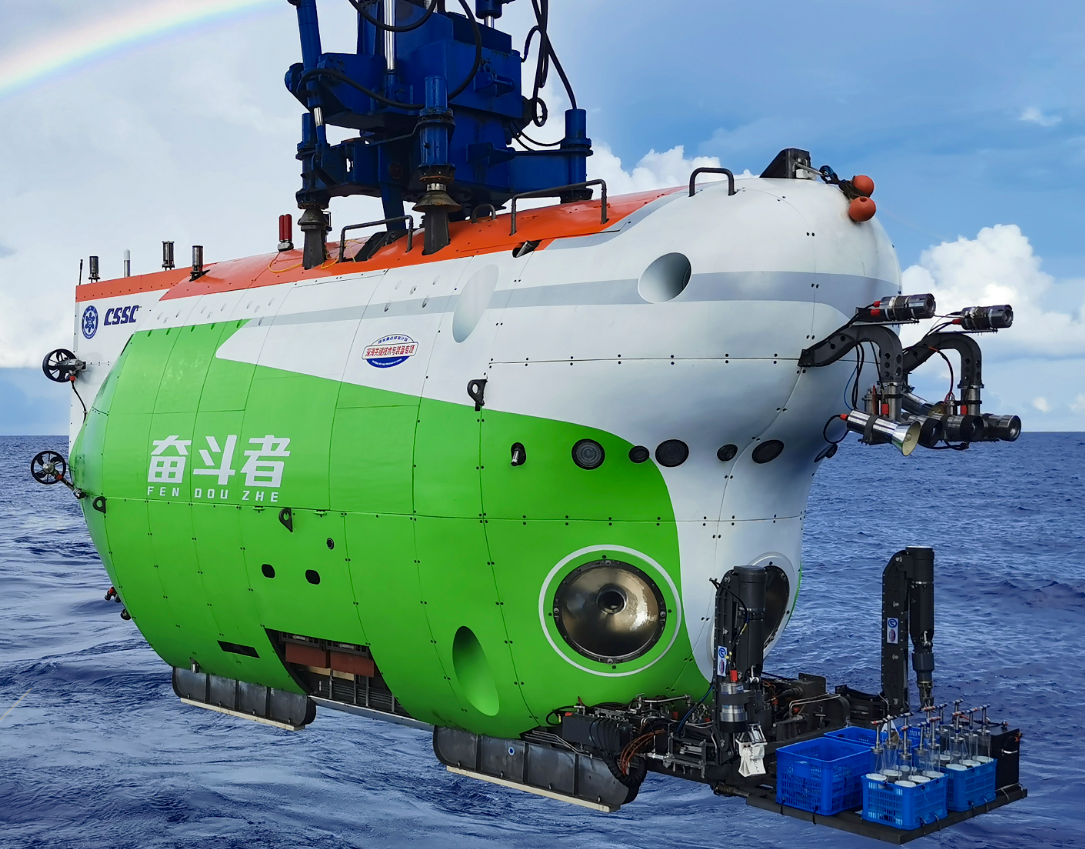
"Zero Defect" Inspection Safeguards Extreme Manufacturing at 10,000 Meters
"This time, the 'Fendouzhe' won the Special Prize of the National Science and Technology Progress Award, and as someone who personally experienced and witnessed it, I feel particularly proud," said Tang Leiping, a senior surveyor at the Shanghai Branch of the China Classification Society.
According to Tang Leiping, the Shanghai Branch of the China Classification Society was fully responsible for the entire construction inspection process of the "Fendouzhe" manned submersible, covering the review of preliminary process documents and test outlines, the inspection of the manufacturing process of various components and raw materials, as well as factory tests of individual parts, overall assembly inspections, and post-assembly system tests, forming a closed-loop inspection chain. "Among all inspection stages, the manned cabin sphere is the most critical and challenging part. Currently, the technical indicators and manufacturing processes of this sphere have reached the world's top level," Tang Leiping said.
Even more stringent is the requirement for "zero defects." "Conventional ship welding may have minor defects, which can be accepted as long as they are within standards, but the 10,000-meter manned sphere cannot have any defects," Tang Leiping explained. "The pressure at the bottom of the ocean is immense, and even tiny cracks or internal stress defects could directly endanger the lives of the divers."
He shared an experience before the sea trial in Sanya: "When I arrived in Sanya late at night, the research participants and divers were actively preparing for the dive. The core project leader told me, 'I feel reassured now that you're here.' This statement made me deeply realize the irreplaceable safety value of the inspection work of the China Classification Society."
From Experimental Application to Routine Operation
On November 10, 2020, the "Fendouzhe" successfully reached the bottom of the Mariana Trench at a depth of 10,909 meters, setting a new record for the deepest manned dive in China. Successfully completing the 10,000-meter sea trial was only the first step. According to the China Classification Society's "Rules for the Classification of Diving Systems and Submersibles," newly built manned submersibles must undergo dismantling inspections after completing maximum-depth dives and navigation trials.
On December 15, 2020, the "Fendouzhe" successfully passed a comprehensive dismantling inspection in Sanya. "According to classification rules, the pressure-resistant hull and other components must be inspected to determine whether there are structural defects," Tang Leiping explained. Inspection results showed that the "Fendouzhe" met technical safety requirements after the 10,000-meter sea trial. On December 18, 2020, the "Fendouzhe" received the 10,000-meter submersible classification certificate issued by the China Classification Society, marking that China's first fully self-developed full-ocean-depth manned submersible met the conditions for delivery and operation.
"Classification is like a vehicle needing inspection before being allowed on the road, and it must pass inspection to obtain a driving license," Tang Leiping compared. The issuance of the classification certificate indicates that the "Fendouzhe" now has an internationally recognized "license to sail," enabling it to participate in international bidding and conduct international business, and marking its transition from experimental application to operational application.
From the "Jiaolong," "Deep Sea Warrior," to the "Fendouzhe," these three deep-sea submersibles had their drawings reviewed by the Shanghai Rules Research Institute of the China Classification Society, underwent on-site inspections by the Shanghai Branch, and were issued classification certificates.
Classification is not the endpoint but the starting point for routine assurance. During the five years of service of the "Fendouzhe," the Shanghai Branch of the China Classification Society has continuously conducted annual inspections, intermediate inspections, and five-year special inspections. Additionally, in cases of equipment damage, fault repairs, or upgrades, the China Classification Society provides professional technical guidance promptly. The China Classification Society also mobilizes key surveyors across branches and regions to form the "Ocean Exploration Inspection Task Force," providing efficient technical services for the "Explorer 1," "Explorer 2," and "Fendouzhe."
As of June 2026, the "Fendouzhe" has completed 522 dives, leading the world in the number of 10,000-meter dives and personnel involved. Numerous domestic and international scientists have conducted joint scientific research, and some countries have even requested China to build similar submersibles for them. "When foreign countries no longer 'choke us' in the field of deep-sea equipment but instead actively seek cooperation, it shows that our technology is now leading globally," Tang Leiping said.
Upgrading Standards to Better Serve the Deep-Sea Equipment Industry
Tang Leiping stated that this year, the China Classification Society's "Rules for the Classification of Diving Systems and Submersibles" will undergo revision and upgrades. "We will incorporate the full-process inspection experience of major projects like the 'Fendouzhe' into the new version of the standards to continuously improve industry norms."
In recent years, the country has increased investment in the deep-sea industry, leading to rapid development in the sector. In May 2025, the operational functions of the China Classification Society's international ship inspection business officially landed in Shanghai, further enhancing its ability to serve the deep-sea equipment industry. "Future deep-sea projects will show two major development trends: first, the routine industrial application of mature technologies, relying on the accumulated mature technologies of the first three generations of submersibles, deep-sea scientific research equipment will be routinely deployed. The focus of the Shanghai Branch's work will be to fully cooperate with clients and strictly control inspection quality. Second, comprehensive breakthroughs in cutting-edge deep-sea technologies, covering areas such as new pressure-resistant materials and core component development. The Shanghai Branch will provide solid technical support for these advancements," Tang Leiping said.
From successful classification after the 10,000-meter sea trial to five years of routine operational assurance, and then to supporting the high-quality development of the deep-sea equipment industry, the Shanghai Branch of the China Classification Society has been deeply involved in the frontline of deep-sea equipment technology inspection for sixteen years. With professional technical capabilities, rigorous inspection services, and reliable technical support, it has continuously ensured the safe and reliable operation of major deep-sea equipment, contributing to China's breakthroughs in key deep-sea technologies and its rise to the forefront of the world. On China's grand journey from shallow blue to deep blue in ocean exploration, the Shanghai Branch of the China Classification Society will bravely shoulder its mission, fully play its role as the "main force" and "national team" in ship inspection, uphold technical standards, tackle technical challenges, actively serve the full-chain needs of deep-sea equipment research, construction, and operation, and always act as the "guardian" of the safety of major national equipment and the "leader" of technological development, continuously contributing solid ship inspection strength to the construction of a maritime power.
-
October 08 International Shipping Trends5877
-
聚焦四个环节 天津海事局全力保障国庆假期涉水施工安全稳定3745
-
Tianjin New Port Maritime Bureau ensures safe loading and convenient shipping of large sintering machine equipment.4385
-
The Yangtze River Zhenjiang section has fully implemented the "Six All" digital closed-loop management system for operations involving hazardous chemical vessels.3505
-
Tianjin North Maritime Bureau Escorts "China's Intelligent Manufacturing" to Sail Overseas4473